
City of Darwin is committed to expanding and enhancing Darwin’s urban forest though its Greening Darwin Strategy2. A key action within the strategy is to plant more shade trees across our parks, reserves and community spaces, and we encourage residents to do the same in their gardens.
See below table of recommended shade trees for Darwin gardens based on a local study by researchers at Charles Darwin University1.
The table includes important attributes to consider when selecting trees and features only Northern Territory native species. Native species provide optimal habitat for wildlife and are well-suited to Darwin’s climate, with monsoon forest species providing the densest shade.
Once you’ve selected your preferred shade tree species, we recommend the following to enhance their cooling effects:
- planting trees in clusters, with individual trees several metres apart, to create a continuous canopy
- using a variety of species to provide year-round food and habitat for native wildlife3.
Further information about these and other native tree species is available in various publications 2, 3, 4, 5.
| Tree species | Common name | Size* | Suited to* | Other notable attributes3,4 |
|---|---|---|---|---|
| Very dense shade | ||||
| Allosyncarpia ternata | Anbinik, Allosyncarpia | XL | LG | Hardy, tolerant to cyclones |
| Carallia brachiata | Bush Currant | M | G | Tolerant to cyclones and wet soils |
| Diospyros compacta | Australian Ebony | S | G | Slow growing but hardy |
| Ganophyllum falcatum | Scaly Ash | M | G | Tolerant to cyclones |
| Maranthes corymbosa | White Cloud Tree | L | LG | Tolerant to cyclones, pendulous foliage |
| Millettia pinnata | Indian Beech | M | SG | Hardy, tolerant to cyclones, highly perfumed flowers |
| Mimusops elengi | Red Condoo/ Spanish Cherry | M | G | Tolerant to cyclones, rounded canopy |
| Nauclea orientalis | Leichhardt Tree | L | LG | Semi-deciduous, tolerant to wet soils |
| Syzygium nervosum | River Apple | L | LG | Tolerant to cyclones, scented leaves, purple fruit |
| Dense shade | ||||
| Alstonia actinophylla | Northern Milkwood | L | LG | Hardy, tolerant to cyclones |
| Peltophorum pterocarpum | Yellow Flame Tree | L | LG | Deciduous, produces yellow flowers |
| Syzygium armstrongii | Bush Apple | M | G | Tolerant to cyclones, produces fruit |
| Moderately dense shade | ||||
| Callitris intratropica | Northern Cypress | M | G | Hardy but fire sensitive, wood aromatic |
| Lophostemon lactifluus | Swamp Box | M | G | Tolerant to wet soils |
*Key
| Size | Height | Example |
|---|---|---|
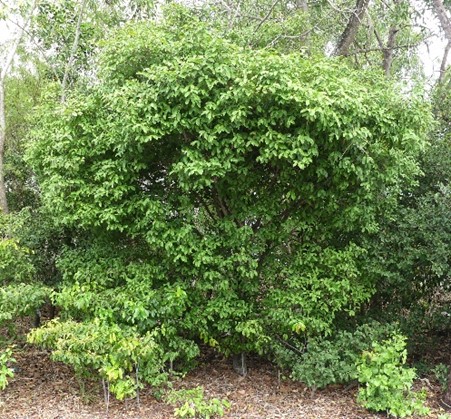
| Small (S) | Usually 3 - 8 metres tall |
Diospyros compacta |
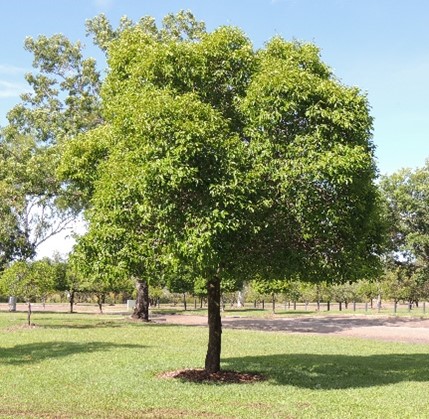
| Medium (M) | Usually 5 - 12 metres tall |
Mimusops elengi |
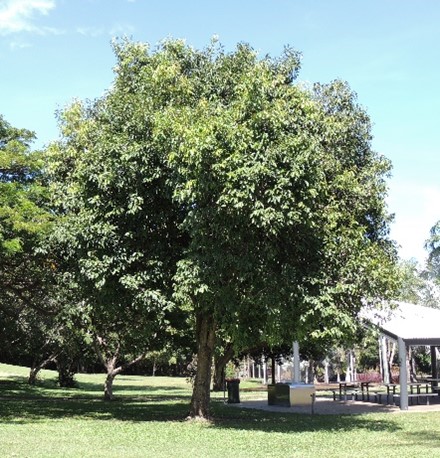
| Large (L) | Up to 20 metres tall |
Syzygium nervosum |
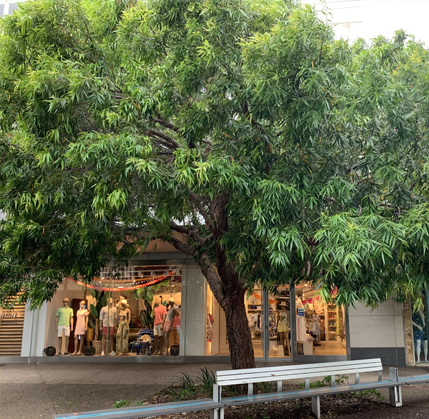
| Extra Large (XL) | Up to 30 metres tall |
Allosyncarpia ternata |
| Label | Suited to |
|---|---|
| Gardens, parks and street trees (G) | Suitable for most gardens |
| Large gardens, parks and street trees (LG) | Larger trees that require more space |
References
- Reynolds, S. 2022. Shading Properties of Native Trees. Charles Darwin University; funded under the City of Darwin Climate Change and Environment Research Grants Program. https://engage.darwin.nt.gov.au/G4WDarwin
- City of Darwin. 2030. Greening Darwin Strategy. https://www.darwin.nt.gov.au/council/about-council/publications-and-forms/greening-darwin-strategy
- City of Darwin. Creating Habitat for Darwin Gardens. https://www.darwin.nt.gov.au/council/about-council/publications-and-forms/creating-habitat-for-darwin-gardens
- Smith, N. 2007. Native Plants for Top End Gardens. Greening Australia, Darwin.
- Brock, J. 2022. Native Plants of Northern Australia (revised edition). Reed New Holland, Sydney.